

Introducing: Sluts 4 Slashers
Is It Feminist or is There Just a Woman in It?

Just a quick reminder that if you aren’t a paid subscriber, that’s okay with me! But please share a quote or restack if you like this. Your personal recommendations are quite actually the frontlines against a total and complete AI takeover of how information is disseminated, taste is shaped, and culture is formed.
A few weeks ago, Raechel Anne Jolie linked to my thoughts about Obsession in my post “Don’t Quote the Deep Magic to Me, Witch.” Raechel and I don’t agree on every aspect of the film (it’s weird to agree entirely on everything all the time, btw), but something she said really stuck with me:
I’m actually fine with the fact that Bear is actually not really an incel, and is in fact a complicated but genuinely nice guy who means so well that he makes a pretty profound choice at the end of the film (a conclusion I really enjoyed, cinematically and plot-wise). But given that, we all ought to do better than to summarize the film as some kind of feminist fable.
Something I’m trying to figure out how to talk about without sounding like an ageist asshole is that I’m not sure a 26-year-old dude who presumably did not study Feminist Theory can really actually tell a story as impactful as feminist audiences are starving for.
I’ve been thinking about the idea of “doing better” when we talk about horror in particular ever since.
If you’ve been reading for a while, you know one of the things I harp on constantly is that culture matters. Not because art functions like propaganda or watching one movie suddenly transforms us into different people, but because we unconsciously absorb values, assumptions, and narratives through culture all the time. We learn what love looks like, what power looks like, what women are supposed to want, what men are supposed to deserve. We learn these things not only from overtly political texts, but from entertainment. Actually, I suspect that in a culture with no gods, no kings, and no real stable or competent authority, we especially learn from entertainment.
Horror is particularly interesting to me because it’s often treated as exempt from this kind of scrutiny. Part of that is because horror fans tend to be smart. I mean that for real. Horror audiences are often highly literate in symbolism, genre conventions, subtext, and cultural critique. They are generally much more willing than audiences in other genres to engage with difficult themes. But I’ve gotta be honest that I have routinely noticed that horror fans can become surprisingly defensive when feminist criticism enters the conversation.
When I wrote about Nosferatu, for example, many readers seemed to interpret my argument as an attack on Robert Eggers himself or on the film’s artistic merit. But that wasn’t what I was saying. My observation was much simpler: Nosferatu is a film in which a young woman’s relationship with a monster begins when he sexually assaults her as a child. Whatever else the film is doing—and it is doing many other things—that fact remains true.
This dynamic reminds me of arguing with liberals who still want to think the Pope is a cute guy with good intentions. At a certain point, I find myself saying: the Church does not believe women are equal to men. Full stop, no comma.
There are all sorts of things one can say in response, although people usually don’t. They could try: The Church has produced extraordinary art. Individual Catholics may hold feminist beliefs. Many priests have devoted their lives to helping others. All of that may be true, but none of it actually alters the original observation. Likewise, a horror film may be visually stunning. It may be emotionally affecting. It may be ambitious, intelligent, and aesthetically accomplished. It may even recognize misogyny and attempt to critique it. But those virtues do not automatically exempt it from reproducing misogynistic assumptions.
The message is still the message. Or perhaps more accurately: the structure is still the structure.
One of the central insights of feminist criticism is that texts frequently communicate values that exceed the intentions of their creators. As Judith Fetterley reminds us in The Resisting Reader: A Feminist Approach to American Fiction: “literature is political,” therefore “the first act of the feminist critic must be to become a resisting rather than an assenting reader." A filmmaker can oppose sexism while reproducing sexist narrative structures. A novel can advocate liberation while quietly restricting the agency of its female characters. A horror film can recognize patriarchy without escaping it. In fact, that’s often where the most interesting criticism begins—not when a text announces its politics, but when its assumptions betray them.
It’s been my own experience that horror audiences (and critics) often treat the recognition of misogyny as equivalent to a critique of misogyny. If a film knows sexism exists, we are often eager to congratulate it for being feminist. But those are not the same thing. Which is how we arrive at our current moment, where movies are routinely described as feminist for reasons that strike me as pretty thin. Here are some off the top:
A woman survives.
A woman kills someone.
A woman has trauma.
A woman is angry.
A woman is the protagonist.
A woman suffers.
A woman suffers symbolically.
A woman suffers metaphorically.
A woman suffers while…idk—bathed in neon lighting.
I’m not arguing that films that fall under this list are inherently un-feminist. Some of them are! Some of them aren’t. Most are probably somewhere in between. What interests me is that we’ve become surprisingly imprecise about what we mean when we use the term, which is weird because feminism itself is not one thing.
A liberal feminist reading of a film may look very different from a radical feminist reading. A Marxist feminist reading may arrive at different conclusions than a psychoanalytic one. Black feminism, queer feminism, ecofeminism, materialist feminism, disability feminism—all of these traditions ask different questions and illuminate different aspects of a text. Which is all to say, I’m not interested in pretending there’s a single correct feminist interpretation of any movie—what I am interested in is asking better questions. For example:
Whose interiority matters?
Whose desires drive the plot?
Who possesses agency?
Who gets punished?
Who gets redeemed?
Who gets to be complicated?
Who gets to make mistakes?
Who gets to survive?
Most importantly: whose story is this, really?
Over the coming months, I’ll be applying various strands of feminist theory to horror films both in theatres and in the Criterion Closet. Some of the films I’m considering include:
The VVitch
The Substance
Obsession
Jennifer’s Body
The Love Witch
Carrie
Teeth
Barbarian
Saint Maud
Pearl
Promising Young Woman
Ginger Snaps
The Craft
So, here’s my Sluts 4 Slashers Feminism Index
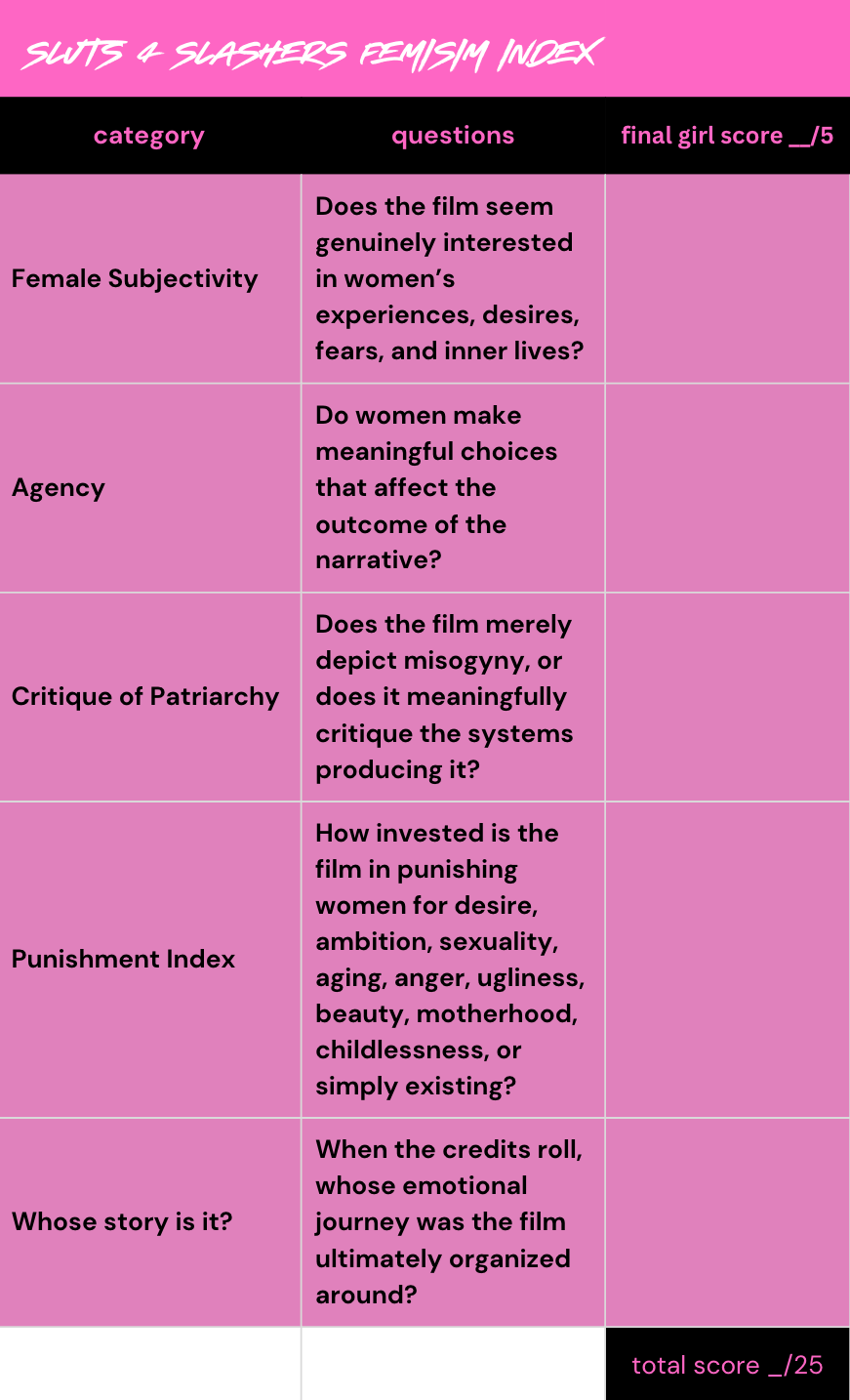
Each category receives a score from one to five Final Girls. The overall score is not a scientific measure, nor is it intended to determine whether a movie is “good” or “bad.” Some of my favorite horror films will almost certainly score poorly. Some films I dislike might do pretty well. My point is not to hand out gold stars for feminism, it’s just to be more precise and, frankly, to do better than calling every movie with a woman in it feminist; to do better than assuming that a film which depicts misogyny has somehow transcended it; and to do better than confusing representation with analysis.
Up first: Obsession (2026) dir. Curry Barker.
Oh, and I’m on Letterboxd. I’d love it if you followed along <3
I'm so excited! Obviously, I love your analysis of pop culture and this is a perfect combination of all of my interests!
Dude I am so pumped for this.