

Work Bitch
Charli XCX, Taylor Swift, & Refusing the Fantasy of Effortlessnes

Just a quick reminder that if you aren’t a paid subscriber, that’s okay with me! But please share a quote or restack if you like this. Your personal recommendations are quite actually the frontlines against a total and complete AI takeover of how information is disseminated, taste is shaped, and culture is formed.
This time last year, my life felt a lot more out of control than I think anyone probably suspected. Publishing can really do that you. There’s no other situation that I’ve experienced in which you put enormous, years long effort into a project with the knowledge that maybe nothing will happen at all. It’s a mindfuck to put so much labor into something that might not pay off, and it’s a bigger mindfuck to send it off for other people to handle. The very concept of an agent is sort uncanny—an entity that goes into the world and works on your behalf while you sit time zones away and hope something good will happen. My agent, Danielle Bukowski, is The Best and everything I could ask for—clear, communicative, smart. Like me, she believes in transparency, hence her really great Substack that you should read if you find the publishing industry murky and mysterious: Just Reading All Day. She’ll answer your questions! But even a great agent doesn’t absolve the loss of control that comes from finally releasing a book that’s been mine and mine alone for a long time.
I’ve been to plenty of Al-Anon meetings and I dutifully follow the command: “God grant me the serenity to accept the things I cannot change, the courage to change the things I can, and the wisdom to know the difference.” (Fun fact: my Grandmother had a pretty print of this quote that she hung up…right in front of the toilet.) That said, career anxiety compounded by a failing relationship had me desperate to figure out what I could change, or rather, control.
My friend Rachel had been talking about lifting heavy for years by that point and had sent me a complicated Google spreadsheet for a progressive overload system at least twice. Apparently, it’s true that you have to hear the same suggestion many times before you finally do it because I didn’t take her advice until I heard Stacey Sims on a podcast talking about longevity and heavy lifting for women. Since my divorce, I’ve become obsessed with being able to live alone for as long as possible. It turns out, one of the best ways to do that is to be really strong. So I finally opened up Rachel’s doc, ordered adjustable dumbbells, and started lifting.
For most of my life, the primary cultural story I’d absorbed about my body and other women’s bodies was that they were something to manage, shrink, perfect, display, repeat. Like most of us, I’ve spent years pursuing control through subtraction. Less food. Less weight. Less space. Lifting is the opposite of that—it’s addition, not subtraction, and I’m not just talking about protein maxxing here. It’s the addition of a time commitment that yields results, slowly, yes, but also undeniably. The day I got into three digits on my deadlift was also the day control stopped feeling like restriction and started feeling like capacity.
This long personal preamble is all to say: I’ve been thinking about the relationship between labor, bodies, and control in relation to Taylor Swift and Charli XCX a lot over the last few months and the occasion of Charli’s recent “Rock Music” has finally compelled me to write about it. Increasingly, both Swift and Charli have been asking us to think about what their bodies can do rather than simply how they look. This is significant since being alive right now feels like being in a sci fi where everyone is shrinking. GLP1s have utterly changed what we see on the screen in a stunningly retrograde return to the 90s body, only now the drug of choice is Ozempic not heroin. So it matters to me that our stars on opposite polls of the pop spectrum both seem preoccupied with a different question: what kind of body does their work require?
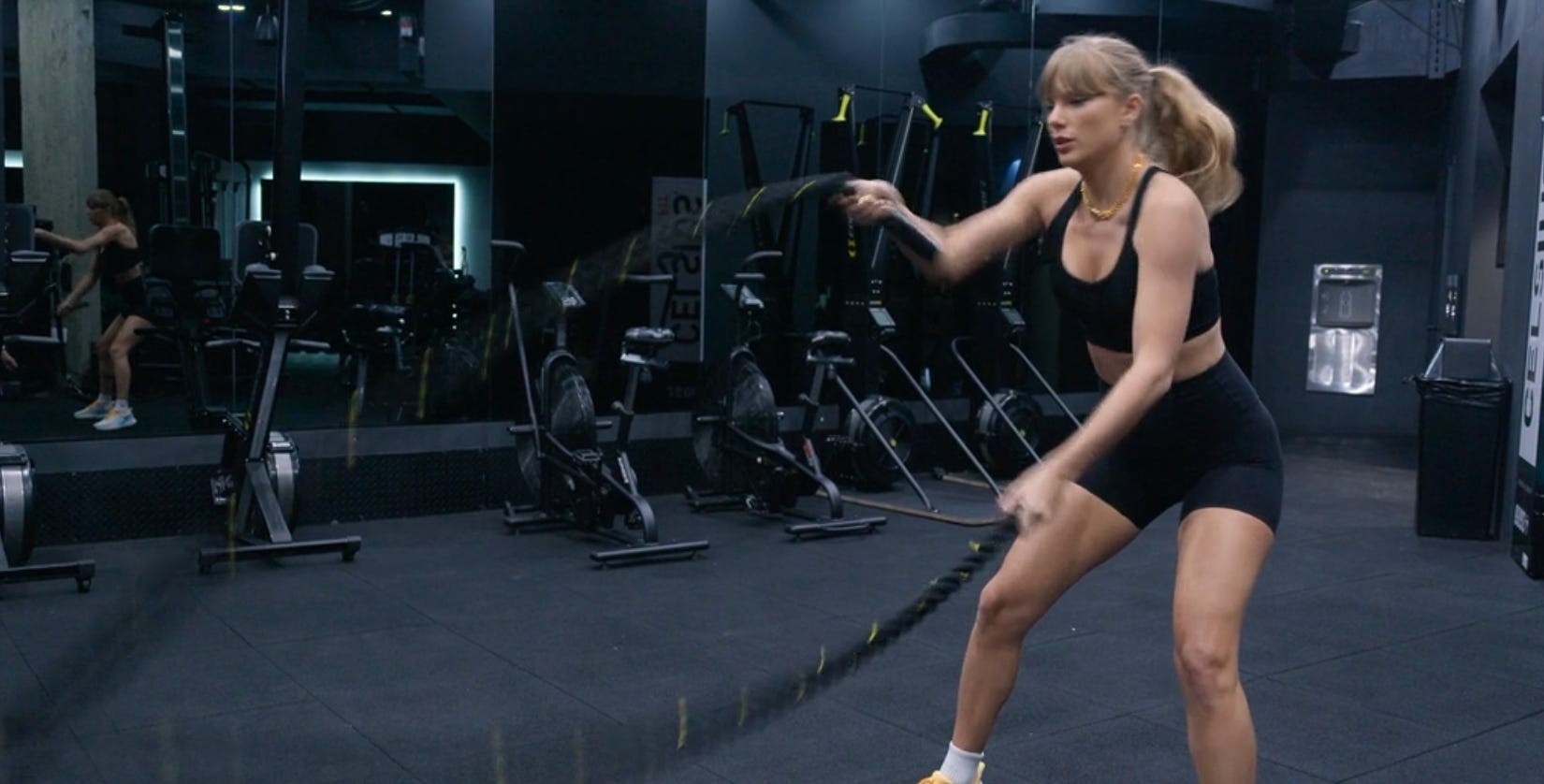
One of the moments from Miss Americana that has stayed with me for years is not actually a scene about songwriting or celebrity or even Trump. It’s the moment where Swift discusses her eating disorder and recalls believing that physical depletion was simply part of being a performer. “I thought that I was supposed to feel like I was going to pass out at the end of a show, or in the middle of it,” she says. What struck me when I first heard that wasn’t even the first part of the quote, but the realization that follows: “No, if you eat food, have energy, get stronger, you can do all these shows.”
Swift isn’t talking about self-esteem or body positivity here. She’s literally just talking about fuel. She’s talking about the relationship between what a body consumes and what a body is capable of doing. The revelation is not framed primarily as a beauty revelation, but as a labor revelation. The only other place I’ve heard this refrain is from the mouth of the mean coach Kelly on America’s Sweethearts, that Dallas Cowboy’s cheerleader doc. Kelly is also only concerned about labor, namely extracting as much of it as she can from her underpaid cheerleaders. Fainting during the kick line in “Thunderstruck” is not a good look for The Brand.
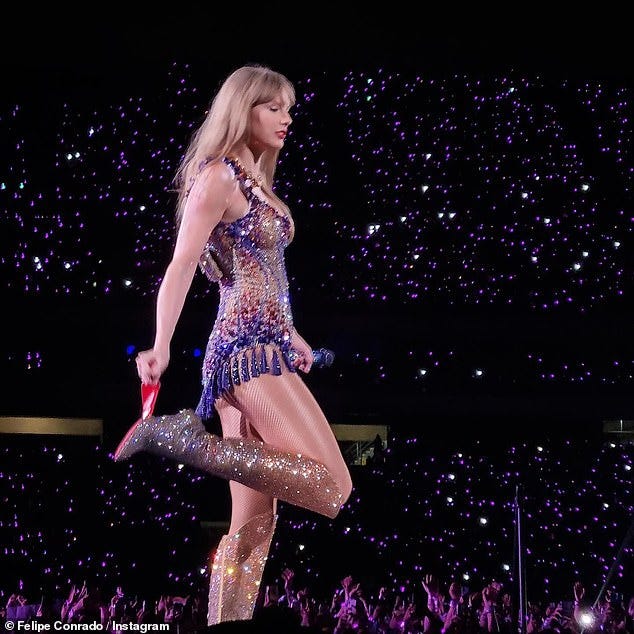
Swift’s remark in Miss Americana seems like foreshadowing (or I guess if you’re a Swiftie you call that an “easter egg”) for the Eras Tour itself, which has been accompanied by so much discussion of preparation, endurance, and physical conditioning. Swift has repeatedly made a choice to speak openly about rehearsing while running on a treadmill, training for months, and preparing her body for the demands of a three-hour show. We have literally seen her recovery room and heard her fiancé say that she works out harder than him on a podcast with a listenership of men. She says that what they have in common is they run around arenas all night long. Nothing Swift does is unorchestrated, so I take this to mean she really, really wants us to know she is working, bitch.
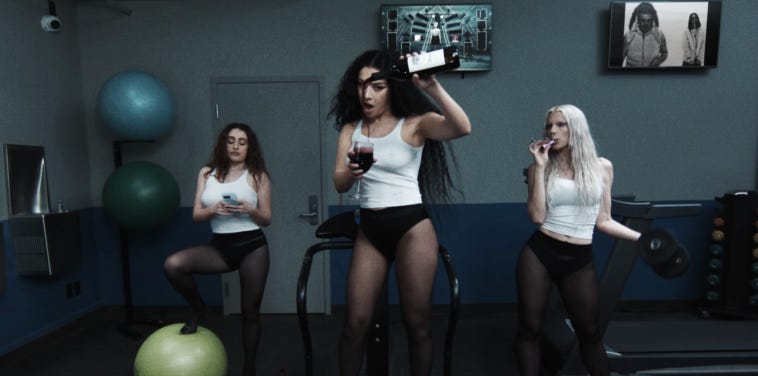
And we do want to know! Myself and the rest of her fans are genuinely fascinated by this part of the lore. At some point the conversation around the tour became not only “look at this performance” but “how is she physically accomplishing this?” The labor became part of the spectacle. In fact, Outside Magazine added it up:
Miles Covered
Between dancing and walking across the stage, Swift took somewhere in the neighborhood of 657,090 steps throughout the duration of the Eras Tour. That’s the equivalent of 329 miles walked across the stage.
Races Completed
It also equates to roughly 12.5 regular-length marathons, 6.5 50-mile ultramarathons, and 3.3 100-mile ultras.
Calories Burned
Using the average number of calories burned per mile walked (which is 100), Swift expended something like 32,900 calories—just in steps. That number is to say nothing of the other dancing, squatting, gyrating, and guitar-holding she did onstage, which burned additional calories, too.
Distance Traveled
Let’s put her steps on a map. Looking at the globe, Swift walked a distance longer than the length of Scotland or the state of Massachusetts. She completed the extent of the John Muir Trail, plus an extra 100 miles.
They end this piece by pointing out she did it in heels.
Charli XCX seems interested in a similar set of questions, albeit from almost the opposite direction. Where Swift tends to emphasize preparation, Charli foregrounds wear and tear. Her recent song “Rock Music” repeatedly returns to the physical consequences of performance:
I’m really hurting my neck
The nerve damage is realMaybe jump off the stage
I hope they catch you todayBut if they don’t, it’s okay!
What I find interesting about these lines is how resolutely unglamorous they are. The body in “Rock Music” is not presented as an image. It is not a fantasy. It is not even particularly aspirational. Also, it’s not a body that has been on the cover of her last two albums. Charli’s is a body being knocked around by its profession, that hurts, that gets injured. A body that, perhaps most importantly, has a job. I find that very fucking relatable.
And actually, in the age of Ozempic I also find it aspirational even though that is certainly not Charli’s point. I’ve found myself returning to an old gender studies classic, Iris Marion Young’s “Throwing Like a Girl” in which she argues that women often experience their bodies simultaneously “as a thing” and “as a capacity.” What struck me revisiting that formulation is how thoroughly contemporary celebrity culture remains invested in the first half of the equation. Women’s bodies are treated as images, brands, and objects of evaluation long before they are treated as instruments capable of action. We are trained to ask how women look before we ask what they do.
Yes, Swift and Charli are very thin and conventionally attractive, but I do think that they’re kind of doing the Lord’s work when they keep redirecting our attention toward the second half of Young’s formulation. Rather than asking us to admire their bodies as objects, they ask us to think about what those bodies are required to accomplish. The body as capacity rather than thing. As action rather than image.
Tressie McMillan Cottom has been on my mind as well, in particular, Thick, in which she argues that beauty functions as a form of capital, but an unstable one. “Beauty is not good capital,” she writes, because its value depends on social arrangements that can shift without warning. I think part of what has been so unexpectedly comforting about lifting weights is that it has changed my relationship to exactly this kind of instability—beauty standards change. Publishing changes. Relationships change. The things other people value are often frustratingly outside my control. But a heavier lift, by contrast, doesn’t depend on anyone but myself. In a time of chaos and shrinking people that’s pretty reassuring.
Ultimately, that’s what I find so compelling about the way both Swift and Charli have been talking about their bodies. In different ways, both women seem committed to making visible the labor that female celebrity has historically been expected to conceal. Swift does it through stories about training, endurance, and fuel. Charli does it through stories about impact, strain, and injury. One foregrounds preparation. The other foregrounds consequences. Both insist that we see the work. And we also see what the work earns—Swift has been clear she did all that labor to buy back her masters. Charli is increasingly included in prestige spaces many pop stars can never access, no matter how famous.
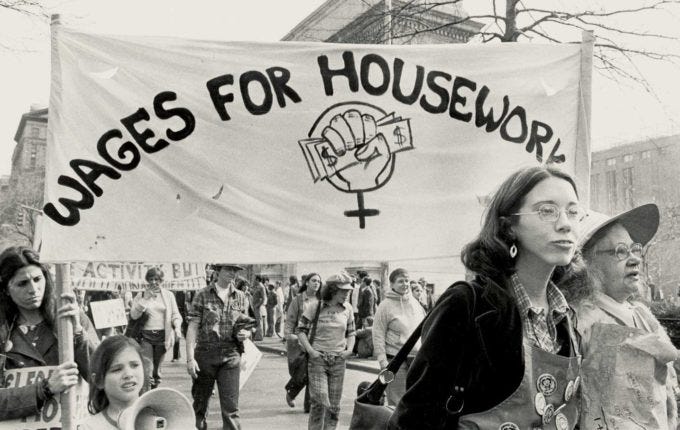
For years, feminist scholars have fought to make invisible labor visible. Housework. Childcare. Emotional labor. Service work. Silvia Federici’s 1975 Wages Against Housework remains one of the most influential examples, in part because she insists that one of capitalism’s most effective tricks is convincing women that labor is not labor at all. Housework appears natural. Caregiving appears natural. The work disappears into femininity itself. As Federici famously puts it,
“They say it is love. We say it is unwaged work.”
So I appreciate it that Swift and Charli keep pulling back the curtain on performance itself by inviting us to look not only at the image but at the effort required to produce it. They keep insisting that we recognize performance as labor rather than treating it as the natural expression of talent, beauty, charisma, or feminine effortlessness.
There is something reassuring about refusing the fantasy of effortlessness. In a cultural that remains dead set on treating women’s bodies primarily as images, conversations not about how small a body can become, but what it is capable of carrying matter. In the immortal words of Britney: You better work, bitch.
Upcoming Events!
I’ll be reading at A Room of One’s Own in Madison, Wisconsin on June 23rd at 6:00 PM with Courtney Ann LaFaive, author of Follow The Signs: Searching for Linda Goodman, America’s Forgotten Astrology Queen. We’ll be talking about our shared interest in astrology as well as the way literature and celebrity engage with esoteric practices.
I LOVE THIS SO MUCH CANDICE.
Can you drop that spreadsheet link?